As usual the period of unusually rational exuberance evident in my last post has given way to the normality of some constantly nagging financial bullshit that has to be dealt with.
Although we have been out of Dubai for a month now we still haven't got our 5000DHS security deposit back nor the last advance rent cheque. We have pleasantly visited the office, phoned numerous times as is the norm here in the absence of any of those promised calls back, but still no cheque. There are no outstanding issues with the flat we vacated and the cast iron evidence is that the flat has already been rented out to someone else.... or so our sources tell us.
So what to do. We called what we thought was the head office only to discover that it the same office we are already dealing with. Everyone there we speak to says it is the responsibility of the man who told us he was waiting for 'head office' to a) inspect the vacated flat ... er ... presumably done before the new tenants moved in? and b) to prepare the cheque. Incidentally this man has now stopped answering our calls.
Have posted question about this on UAE community blog but it is one of those UAE things that I can never get used to... that constant feeling of slight nausea because you know that however good things seem to have got there is always another fucking battle just around the corner.
Saturday, 20 December 2008

Wednesday, 10 December 2008
I love Sharjah ..
Sharjah rocks! It is so weird. It's just down the road from Dub but is like being in a totally different country. I feel like my feet actually connect to solid ground in Sharjah. In Dubai I always felt like I was walking on ice somehow and was never quite sure how thick it was. Even the taxi drivers are different. They have all the same problems but seem less stressed out than Dubai taxi drivers despite the nightmare of central Sharjah traffic.
Also Sharjah has got off to a very positive start in a way Dubai didn't for me. Completely out of the blue and starting the week I actually moved here, was a gift of a job working with the Sharjah Biennale and Bidoun Magazine. I have absolutely no doubt whatsoever that this is the coolest job in the universe and I can hardly believe its mine! As a consequence I have been allah kareeming and ulhumdulillahing all over the place which goes down very well in Sharjah. What;s more the job is based right in the middle of Sharjah's arts and heritage area which is just ... well.. ..ulhumdulillah.... see what I mean?!
Another positive is of course the weather... numerous thunderstorms last week and lots of lovely rain! I know it didn't rain much in Dubai last winter (apart from the three days that George Bush came), but the only time I heard thunder in Dubai was that weird day they seeded the clouds!
So .. I don't actually miss anything about Dubai yet although next week is the Dubai International Film Festival and I'm sure that taxi-ing in and out of Dubai most days is going to be a complete pain in the proverbial. But I sneaked a press pass again which means I get free tickets so I ain't complaining!
Also Sharjah has got off to a very positive start in a way Dubai didn't for me. Completely out of the blue and starting the week I actually moved here, was a gift of a job working with the Sharjah Biennale and Bidoun Magazine. I have absolutely no doubt whatsoever that this is the coolest job in the universe and I can hardly believe its mine! As a consequence I have been allah kareeming and ulhumdulillahing all over the place which goes down very well in Sharjah. What;s more the job is based right in the middle of Sharjah's arts and heritage area which is just ... well.. ..ulhumdulillah.... see what I mean?!
Another positive is of course the weather... numerous thunderstorms last week and lots of lovely rain! I know it didn't rain much in Dubai last winter (apart from the three days that George Bush came), but the only time I heard thunder in Dubai was that weird day they seeded the clouds!
So .. I don't actually miss anything about Dubai yet although next week is the Dubai International Film Festival and I'm sure that taxi-ing in and out of Dubai most days is going to be a complete pain in the proverbial. But I sneaked a press pass again which means I get free tickets so I ain't complaining!
Sunday, 7 December 2008
Art Paris Abu Dhabi
This year’s Art Paris-Abu Dhabi seemed very different to last year. However, I’m not sure if this is just my perception or if there really was an objective shift in focus. It definitely seemed less ‘European’ but perhaps this is because one of the first gallery stands in the main hall was the UK's Waterhouse and Dodds. This stand contained a who’s who of regional big hitters and earners. Farhad Moshiri – check, Shirin Neshat – check, Parviz Tanavoli – check, Charles Hossein Zenderoudi – check. Yawn – check.
Most prominently displayed was Lalla Essaydi’s triptych of a figure reclining in an interior with everything covered in Arabic script. Displayed below, was the centrefold of the National with the same image reproduced as part of a feature on the art collection of Abu Dhabi’s Crown Prince, Mohammed Bin Zayed which magically appeared two days before the opening! Worries that sales would be affected by the global downturn was evidently not something Essaydi had to worrry about nor probably any other artists in MBZ's collection!
This start set a slightly weary tone for my trip around the fair this year although a few other things did register. Enrico Navarra had an event-specific graffiti work drawn on paper around the wall of one part of its stand. This was absolutely inspired and I sincerely hope that it was snapped up for the MBZ collection.
Patrice Trigano, had several works by photographer Julien Leclerc including one mesmerising image of a bullfight. The merging of the component parts of the image was reminscent of Picassos ‘Death of a Female Toreador’ although it was a defintive victory for the toreador in this case. Another work which was essentially a study of wet sand, was also mesmerising in its textured and shadowed simplicity. Both of these images were like strong silent types providing a reassuring antidote to the political noise of some of the middle eastern work.
This perception of noise also struck me at the Tamenaga gallery showing the work of Cheng Jiang Hong and Kyosuke Tchinai. Both artists were obviously absorbed in a purely creative process which reconstructed and reinterpreted parts of their own art histories. There was a narrative thread in Hong’s work which almost read like a book and Tchinai had merged all the most recognisable features of traditional Japanese technique into images that were 2D but sculptural in their impact. One image in particular was so breathtaking I understood for the first time in my life why people spend money they don’t have.
After this I wandered aimlessly around the rest of the fair feeling slightly guilty for being irritated with ‘modern middle eastern art’ although perhaps it’s just the Iranians I’m bored with. Ahmad Mualla’s huge painting at Green Art Gallery was stunning and Lara Baladi’s beach collages at B21 are pure entertainment.
Guy Ferrer and Bernard Pras, the only artists being shown by Nathalie Gaillard, were also memorable. In a context where many small spaces are often overstuffed with multiple artists and styles, a minimal display technique can be very effective!
Most prominently displayed was Lalla Essaydi’s triptych of a figure reclining in an interior with everything covered in Arabic script. Displayed below, was the centrefold of the National with the same image reproduced as part of a feature on the art collection of Abu Dhabi’s Crown Prince, Mohammed Bin Zayed which magically appeared two days before the opening! Worries that sales would be affected by the global downturn was evidently not something Essaydi had to worrry about nor probably any other artists in MBZ's collection!
This start set a slightly weary tone for my trip around the fair this year although a few other things did register. Enrico Navarra had an event-specific graffiti work drawn on paper around the wall of one part of its stand. This was absolutely inspired and I sincerely hope that it was snapped up for the MBZ collection.
Patrice Trigano, had several works by photographer Julien Leclerc including one mesmerising image of a bullfight. The merging of the component parts of the image was reminscent of Picassos ‘Death of a Female Toreador’ although it was a defintive victory for the toreador in this case. Another work which was essentially a study of wet sand, was also mesmerising in its textured and shadowed simplicity. Both of these images were like strong silent types providing a reassuring antidote to the political noise of some of the middle eastern work.
This perception of noise also struck me at the Tamenaga gallery showing the work of Cheng Jiang Hong and Kyosuke Tchinai. Both artists were obviously absorbed in a purely creative process which reconstructed and reinterpreted parts of their own art histories. There was a narrative thread in Hong’s work which almost read like a book and Tchinai had merged all the most recognisable features of traditional Japanese technique into images that were 2D but sculptural in their impact. One image in particular was so breathtaking I understood for the first time in my life why people spend money they don’t have.
After this I wandered aimlessly around the rest of the fair feeling slightly guilty for being irritated with ‘modern middle eastern art’ although perhaps it’s just the Iranians I’m bored with. Ahmad Mualla’s huge painting at Green Art Gallery was stunning and Lara Baladi’s beach collages at B21 are pure entertainment.
Guy Ferrer and Bernard Pras, the only artists being shown by Nathalie Gaillard, were also memorable. In a context where many small spaces are often overstuffed with multiple artists and styles, a minimal display technique can be very effective!
Thursday, 13 November 2008
Squatting and Exhibiting in Dubai


Countdown to Sharjah has entered final week and I am re-visiting a bizarre combination of two periods in my life - squatting and being a student.
Spouse has secured furnished apartment in the People's Great Neighbouring Jumhurriyah so with assistance from Dubizzle and the Spinneys noticeboard I have been furniture souk central all this week. As of two days ago I have had no fridge, cooker, washing machine, bed or sofa. This means I am sleeping on a mattress on the floor and living primarily off of Korean pot noodle. Given the absence of any other form of entertainment since the TV left, I am also playing a disturbing amount of PC games.
When I was a student PCs didn't exist so entertainment consisted mostly of music which I still have here except it is now all on one small device. So all I need is a case of warm beer and a carton of Marlboro and I could pretend to be 21 again......probably not a good idea.
Given these circumstances it is amazing that I managed to scrub up well enough to attend the opening of 'Women in Art IV' at the Courtyard Gallery this week. I have three paintings in this show (above) which ends on November 20th and then its off to Sharj 2 days later. I'm really glad that I could end my time living in Dubai with an exhibition.
PS. If anyone wants a cheap as chips dining table, desk, office chair and bookcase let me know!
Tuesday, 4 November 2008
Day trip to Islamic Civilisation
In line with my imminent move to the centre of the known local cultural universe, I just paid a visit to the Sharjah Museums Department. Sharjah has more museums than the rest of the Emirates combined and in the past year it really seems to have been getting its act together.
Arty types are more likely to know about Sharjah because of the biennale which predates any substantial ‘arty’ offerings from Abu Dhabi or Dubai. Even so I have never understood why Sharjah and its assets don’t get more press or other coverage.
I suppose it’s partly because Sharjah doesn’t have the manic self promotional tendencies of its neighbours and has nothing to prove in the cultural arena anyway. By contrast both Dubai and Abu Dhabi seem desperate to promote their respective ‘visions’ of the UAE’s cultural future and their roles in it. Unfortunately, the words ‘vision’ and ‘future’ are not much use to somebody who needs a regular injection of ‘reality’ and ‘present’ and this Sharjah visit gave me a good dose of both.
The museums department now has an educational section for promoting Sharjah’s museums of archaeology, natural and social history, calligraphy, art, aviation and several more. Although these institutions are always good for attracting stray tourists, the focus of the educational department’s outreach is decidedly local. This means nationals, residents, schools and universities. There are family activities, school activities, cultural awareness programmes and some very cool stuff to see especially in the jewel in the Sharjah crown, the new Museum of Islamic Civilisation.
The museum only opened last June and contains a fascinating and extensive collection of historical, scientific and cultural artefacts. Some of these have been donated or purchased especially for the museum but the majority apparently constitute the personal collection of Sharjah’s ruler.
The first floor is dedicated to science and technology. This includes astronomy, navigation, medicine and chemistry and I was delighted to see a whole cabinet of astrolabes. I like astrolabes and this is the first time I have actually seen one for real! They are amazing inventions but are also works of art and craftsmanship in their own right.
Another delightful surprise was the ballistics and weapons section which I don’t want to ruin by describing too much. Let’s just say there are certain aspects that animal rights activists may object to, although the animals used in early biological weapons programmes probably survived.
The second floor is dedicated to the art and craftsmanship of the Islamic world. There are pieces of ancient text and Quranic script carved into wood and stone. Ceramics, metalwork, glass, models of gardens, ancient buildings and architecture.
It was very refreshing to be in a building full of old stuff displayed well and relevant to the location. In fact this trip confirmed for me that Sharjah truly is the centre to which all futures must refer if they wish to maintain a connection to their past. Go Sharjah!!
Arty types are more likely to know about Sharjah because of the biennale which predates any substantial ‘arty’ offerings from Abu Dhabi or Dubai. Even so I have never understood why Sharjah and its assets don’t get more press or other coverage.
I suppose it’s partly because Sharjah doesn’t have the manic self promotional tendencies of its neighbours and has nothing to prove in the cultural arena anyway. By contrast both Dubai and Abu Dhabi seem desperate to promote their respective ‘visions’ of the UAE’s cultural future and their roles in it. Unfortunately, the words ‘vision’ and ‘future’ are not much use to somebody who needs a regular injection of ‘reality’ and ‘present’ and this Sharjah visit gave me a good dose of both.
The museums department now has an educational section for promoting Sharjah’s museums of archaeology, natural and social history, calligraphy, art, aviation and several more. Although these institutions are always good for attracting stray tourists, the focus of the educational department’s outreach is decidedly local. This means nationals, residents, schools and universities. There are family activities, school activities, cultural awareness programmes and some very cool stuff to see especially in the jewel in the Sharjah crown, the new Museum of Islamic Civilisation.
The museum only opened last June and contains a fascinating and extensive collection of historical, scientific and cultural artefacts. Some of these have been donated or purchased especially for the museum but the majority apparently constitute the personal collection of Sharjah’s ruler.
The first floor is dedicated to science and technology. This includes astronomy, navigation, medicine and chemistry and I was delighted to see a whole cabinet of astrolabes. I like astrolabes and this is the first time I have actually seen one for real! They are amazing inventions but are also works of art and craftsmanship in their own right.
Another delightful surprise was the ballistics and weapons section which I don’t want to ruin by describing too much. Let’s just say there are certain aspects that animal rights activists may object to, although the animals used in early biological weapons programmes probably survived.
The second floor is dedicated to the art and craftsmanship of the Islamic world. There are pieces of ancient text and Quranic script carved into wood and stone. Ceramics, metalwork, glass, models of gardens, ancient buildings and architecture.
It was very refreshing to be in a building full of old stuff displayed well and relevant to the location. In fact this trip confirmed for me that Sharjah truly is the centre to which all futures must refer if they wish to maintain a connection to their past. Go Sharjah!!
Sunday, 26 October 2008
Land, Art and the Environment


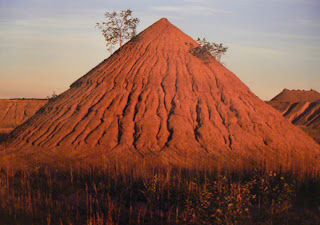


Last week I was lucky enough to be involved in a panel discussion and exhibition at the Cultural Foundation in Abu Dhabi. Organised by the Abu Dhabi Authority of Culture and Heritage and the Goethe-Institut Gulf Region, the exhibition runs until November 1st.
The panel was chaired by Konstantin Schreiber of Deutsche Welle TV and featured artists who work in some way with environmental issues. The main artist, German photographer Petra Petrick exhibited a series of photographs called ‘German Desert’. The images are desolate, barren and beautiful just like real deserts but actually taken at the abandoned sites of former open cast coalmines in Germany.
Khorfakkan artist Abdullah al Saadi exhibited a wall length panoramic scroll of the Khorfakkan coastline created while in a boat looking back at the coast. His work monitors the change in the landscape as new buildings, especially hotels, arise and aspects of the natural landscape are removed. In some cases this includes parts of mountains.
Muna al Ali arranges potted plants in various stages of growth to comment on the inevitable cycles of life and decay to which we are all subject. The first time I saw this installation called ‘Dialogue with Nature’ was in the Creek Art fair last March. At that time all the plants were very healthy looking but now the dialogue is communicating something much less optimistic.
My work consisted of three ‘Towers of Trash’ which also featured in the Creek Art fair last year, and two ‘Artificial Landscapes’. These are painted on recycled board and depict landscapes but in a totally artificial way using unnatural colours, perspectives and materials.
Mohammed Kazem had several photographs in the exhibition illustrating the rapid urbanisation of the landscape around Dubai and more abstracted work using details of the urban emnvironment.
In the panel discussion itself the artists talked about how their work relates to changes in the environment around them and reflects and interprets these changes. Petra Petrick’s haunting photographs are testament to industrially devastated landscapes and Abdullah al Saadi is chronicling contemporary landscape loss. My work tries to address the fact that there are long-term consequences of having one of the highest amounts of waste per capita and Muna al Ali reminds us of the inevitable!
While the undeniable benefits of development are visible, the negatives, particularly in relation to the environment, tend to be invisible in the short term so are easy to ignore. However, none of this work is meant as an unambiguous criticism of development or Dubai but is more a mechanism to raise questions about issues of land use, environmental sustainability and even public health. Ultimately the environment is the great leveller. We are all equally dependent on it for our survival not only as individuals but also as a species. From a creative point of view it has been the inspiration for some of the world’s greatest art, greatest music and greatest poetry. If it changes we change with it and as Muna’s work suggests, a dialogue with nature is probably easier while it still seems relatively healthy!
Friday, 17 October 2008
Critiquing Art at the DIFC
The first of four panel discussions arranged to coincide with the photographic exhibition ‘To the Holy Lands’ was held last week at DIFC. Entitled 'Critiquing Art: factors in critiquing art within the Modern Middle East' the panel explored some of the cultural dynamics associated with art criticism in this region.
One comment made about the purpose of the forum was to bring like-minded people together to begin a dialogue that underpins the UAEs current art boom and ultimately contributes to its sustainability. This is a noble aim but I don’t get out as much as I probably should so unfortunately didn’t recognise most of the people in the room! It would have been very useful if there had been a participant list available especially one with affiliations so that we all know who the interested parties are.
Another aim was to explore the difficulties of critique in a media environment that tends to cut and paste the press release and where public criticism of any kind is considered negative. There is a rather large gap between this context and the occidental view of criticism as a separate discipline necessary for creative and intellectual development.
One question raised by panellist Stephanie Sykes, Communications Manager of Art Dubai, was ‘Who makes the best art critic?’ Another panellist, artist, critic and curator Talal Mualla seemed to think that artists themselves were in the best position to be critics. In his view, the way in which artists relate to wider cultural, political and historical contexts enables them to situate and interpret the work more accurately.
This may be true but it does not necessarily mean that artists are the best critics. They have a vested interest in promoting their own craft and their understanding and respect for the creative process itself can reduce their critical judgment of the final product. However, this approach probably makes them ideal critics in the environment under discussion!
It’s a shame that this issue wasn’t explored further but it got me thinking about the definition of art critic. To paraphrase from my new favourite book ‘Art Criticism – a User’s Guide’ there are several types of critic:
The Advocate – promotes artists he or she admires and compares others unfavourably
The Theoretician – interprets the context of each work rather than its form or content
The Progressive – welcomes and promotes innovation and new forms
The Ideologue – interprets through a structure of political or social commitment
The Traditionalist – reviews what is new in terms of its relationship to the past
Related to this my book also says there are several types of criticism - thematic, geographical, technical, chronological and theoretical – none of which sound particularly nasty to me. In fact all of the above just seem to be flexible structures or at least starting points for forming an opinion. Despite its name art criticism is not automatically 'critical'.
Given the creative mergers and acquisitions of globalism and technology over recent years it is tempting to think that approaches to criticism must also shift but maintaining some structural consistency amid often chaotic change is probably more useful. That said there is too much happening to be covered by traditional means anyway and changes in the nature of communication enable artists, or anybody else, to say essentially what they like. However, this is most often small groups of people talking amongst themselves so issues of quality control are probably moot. Ultimately, established and traditional authorities of art criticism are likely to prevail until new ones emerge strongly enough from new global settings to challenge them. This relates to the other big unexplored question for me which was ‘Who is it for?
The panel was essentially about Middle Eastern art and while it is always worthwhile to get good information out there in any language, most of it is in English. If the dialogue is about developing and sustaining creativity in the Middle East where are the Arabic commentators? There are loads of Arabic blogs and forums out there so surely some of them must be about art and culture in the region. If anyone knows please tell me. I won’t be able to read them but I know people who can and it would be good just to know they are there!
The other discussion are as follows:
October 15th - 'Digitally Restoring Photographs: practical techniques
October 22nd - 'The History of Photography and Contemporary Photography in the Gulf Region'
October 28th - 'How to run an exhibition: Art Management'
One comment made about the purpose of the forum was to bring like-minded people together to begin a dialogue that underpins the UAEs current art boom and ultimately contributes to its sustainability. This is a noble aim but I don’t get out as much as I probably should so unfortunately didn’t recognise most of the people in the room! It would have been very useful if there had been a participant list available especially one with affiliations so that we all know who the interested parties are.
Another aim was to explore the difficulties of critique in a media environment that tends to cut and paste the press release and where public criticism of any kind is considered negative. There is a rather large gap between this context and the occidental view of criticism as a separate discipline necessary for creative and intellectual development.
One question raised by panellist Stephanie Sykes, Communications Manager of Art Dubai, was ‘Who makes the best art critic?’ Another panellist, artist, critic and curator Talal Mualla seemed to think that artists themselves were in the best position to be critics. In his view, the way in which artists relate to wider cultural, political and historical contexts enables them to situate and interpret the work more accurately.
This may be true but it does not necessarily mean that artists are the best critics. They have a vested interest in promoting their own craft and their understanding and respect for the creative process itself can reduce their critical judgment of the final product. However, this approach probably makes them ideal critics in the environment under discussion!
It’s a shame that this issue wasn’t explored further but it got me thinking about the definition of art critic. To paraphrase from my new favourite book ‘Art Criticism – a User’s Guide’ there are several types of critic:
The Advocate – promotes artists he or she admires and compares others unfavourably
The Theoretician – interprets the context of each work rather than its form or content
The Progressive – welcomes and promotes innovation and new forms
The Ideologue – interprets through a structure of political or social commitment
The Traditionalist – reviews what is new in terms of its relationship to the past
Related to this my book also says there are several types of criticism - thematic, geographical, technical, chronological and theoretical – none of which sound particularly nasty to me. In fact all of the above just seem to be flexible structures or at least starting points for forming an opinion. Despite its name art criticism is not automatically 'critical'.
Given the creative mergers and acquisitions of globalism and technology over recent years it is tempting to think that approaches to criticism must also shift but maintaining some structural consistency amid often chaotic change is probably more useful. That said there is too much happening to be covered by traditional means anyway and changes in the nature of communication enable artists, or anybody else, to say essentially what they like. However, this is most often small groups of people talking amongst themselves so issues of quality control are probably moot. Ultimately, established and traditional authorities of art criticism are likely to prevail until new ones emerge strongly enough from new global settings to challenge them. This relates to the other big unexplored question for me which was ‘Who is it for?
The panel was essentially about Middle Eastern art and while it is always worthwhile to get good information out there in any language, most of it is in English. If the dialogue is about developing and sustaining creativity in the Middle East where are the Arabic commentators? There are loads of Arabic blogs and forums out there so surely some of them must be about art and culture in the region. If anyone knows please tell me. I won’t be able to read them but I know people who can and it would be good just to know they are there!
The other discussion are as follows:
October 15th - 'Digitally Restoring Photographs: practical techniques
October 22nd - 'The History of Photography and Contemporary Photography in the Gulf Region'
October 28th - 'How to run an exhibition: Art Management'
Monday, 13 October 2008
'Let's Talk' Grey Noise at the Jam Jar


For me the most interesting thing at Art Dubai last year was the Pakistan Pavilion. The work seemed very fresh and was generally brain engaging in a way that much other contemporary work there was not. Because of this experience I was looking forward to seeing the collaboration between five young Pakistani artists from the Grey Noise Gallery in Lahore and the Jam Jar in Dubai.
'Let’s Talk’ came about after a meeting between Hetal Pawani of the Jam Jar and Umer Butt of Grey Noise. The exhibition represents a dialogue between the five artists and the work is linked as if it were a conversation. The central pillar of the whole concept is a small catalogue containing actual email dialogue and images the five artists exchanged when the show was in the planning stage. It is essential to read this catalogue, not only to help you understand what you see, but also because it creates a strong sense of personal involvement in the show.
The catalogue provides a basic structure of the conversation being had in the work. After that it is up to you to work out exactly where and how the different layers of the conversation intersect. This is challenging in itself because it is not always obvious. Just like a real conversation there are things that are unsaid, slight tangents and unresolved points. However, when juxtaposing the conversation being had by the work with the emailed exchanges between the artists, the show becomes a complete and cohesive entity. Silences in one and omissions in the other also become comprehensible.
The strongest conversational thread in the work is music or sound. The show starts with Lala Rukh’s sound collage containing elements of nature, politics and traditional music. Following on from this is Ayesha Jatoi’s line of sound words running the length of the opposite wall ending in the word ‘boom’. A full stop is provided by a very simple abstract red and white print entitled ‘Where is my God’? Turning the corner you see six small white graves each containing a different book. The interesting mix of titles spans a time frame of more than 10 years but the most recent is the biography of Benazir Bhutto. The creator of these works, Ayaz Jokhio, is strangely absent from the catalogue discussion.
Next is one of Mehreen Murtaza’s large prints evoking sci-fi, technology, creation and myth, an image that does not seem to relate directly to the conversation but is understood when placed in the context of the email exchanges. Her other print relates more directly to the sound motif but also explores faith and technology as instruments of control.
Around the next corner ‘Echo’ and ‘Sleeper’ by Fahd Burki are not what you expect to see having read the email exchanges and this intensifies the feeling that you have established an intimate relationship with the artists. The connection to the conversation in terms of sound is obvious but there are other more subtle undercurrents that can also be divined from the information you have been given.
It’s difficult to elaborate further because the presence of the catalogue is so central to the experience. It becomes like a puzzle, which you have to solve and the more effort you put into it the more rewarding it is. It is a nice redefinition of interactive - one in which exclusively mental rather than physical processes become the ones interacting with the work. What is perhaps most amazing is that you get all this from only eight pieces of work and a rather diminutive catalogue! So the show may be small but it is perfectly formed.
'Let’s Talk’ came about after a meeting between Hetal Pawani of the Jam Jar and Umer Butt of Grey Noise. The exhibition represents a dialogue between the five artists and the work is linked as if it were a conversation. The central pillar of the whole concept is a small catalogue containing actual email dialogue and images the five artists exchanged when the show was in the planning stage. It is essential to read this catalogue, not only to help you understand what you see, but also because it creates a strong sense of personal involvement in the show.
The catalogue provides a basic structure of the conversation being had in the work. After that it is up to you to work out exactly where and how the different layers of the conversation intersect. This is challenging in itself because it is not always obvious. Just like a real conversation there are things that are unsaid, slight tangents and unresolved points. However, when juxtaposing the conversation being had by the work with the emailed exchanges between the artists, the show becomes a complete and cohesive entity. Silences in one and omissions in the other also become comprehensible.
The strongest conversational thread in the work is music or sound. The show starts with Lala Rukh’s sound collage containing elements of nature, politics and traditional music. Following on from this is Ayesha Jatoi’s line of sound words running the length of the opposite wall ending in the word ‘boom’. A full stop is provided by a very simple abstract red and white print entitled ‘Where is my God’? Turning the corner you see six small white graves each containing a different book. The interesting mix of titles spans a time frame of more than 10 years but the most recent is the biography of Benazir Bhutto. The creator of these works, Ayaz Jokhio, is strangely absent from the catalogue discussion.
Next is one of Mehreen Murtaza’s large prints evoking sci-fi, technology, creation and myth, an image that does not seem to relate directly to the conversation but is understood when placed in the context of the email exchanges. Her other print relates more directly to the sound motif but also explores faith and technology as instruments of control.
Around the next corner ‘Echo’ and ‘Sleeper’ by Fahd Burki are not what you expect to see having read the email exchanges and this intensifies the feeling that you have established an intimate relationship with the artists. The connection to the conversation in terms of sound is obvious but there are other more subtle undercurrents that can also be divined from the information you have been given.
It’s difficult to elaborate further because the presence of the catalogue is so central to the experience. It becomes like a puzzle, which you have to solve and the more effort you put into it the more rewarding it is. It is a nice redefinition of interactive - one in which exclusively mental rather than physical processes become the ones interacting with the work. What is perhaps most amazing is that you get all this from only eight pieces of work and a rather diminutive catalogue! So the show may be small but it is perfectly formed.
That said you do leave wanting more. Although you can keep reflecting on the concept and the different ways in which the conversation works, you want it to develop. Perhaps into another room, with another catalogue, different artists and a counter argument! However, this would be a different show and it probably needs to remain small because another thing I found was that it was hard to see the individual pieces in their own right. They became secondary to the larger concept and it was that, and the mental challenges associated with this show, which remained rather than the work itself. Nevertheless, Pakistan is still up there on my ‘to do further’ list!
Tuesday, 7 October 2008
Sharjah on my mind
After a few weeks of frantic scrabbling around for new gainful employment in Dubai I have come to some conclusions. First is that I may have done it from scratch once but I really don't have the energy to do it all over again. After what happened with my previous job I don't have the motivation either.... and it is this which presents the biggest problem.
I have also found that my previous job was done in such a vacuum it doesn't seem to translate to anything outside of it. So my year of working on a pioneering culture and arts project in Dubai is irrelevant because I cannot use the knowledge gained to get another job. This is very disturbing. If the experience is irrelevant here, what possible use can it be elsewhere? There is a metaphor in here somewhere but I haven't worked out what it is yet.
Another thing is that there is some confusion about what 'freelance' means! The reaction I got from my employers when informed that my job had disappeared was 'but it's ok, you're freelance right?' When you start a project with an end date in spring 2009 you don't expect it to disappear in Autumn 2008! In this scenario 'freelance' just seems to mean an employee who is effortlessly and guiltlessly disposable (tho' the G word is probably redundant in this context!).
Anyway I have thrown in the Dubai towel, given notice on the flat and am relocating to Sharjah. Spouse has already made this move to a new job with rent paid. We figured that we could keep the flat on in Dubai and he could come for weekends but now I am not earning that is impossible so Sharjah here I come. Who knows we may even recoup some of the financial losses incurred by Dubai!
I am sure that things would have been different if we had been a) luckier and b) 10 years younger! The people I have met who seem happiest here are generally under 35, have a car and have no property or other financial commitments elsewhere unlike us. In some ways they remind me of myself in Japan in the mid 80s. Tokyo was a boom town, the money was flowing, my income was highly disposable and it was absolutely fantastic!
Aaahhh.... the good old days...
I have also found that my previous job was done in such a vacuum it doesn't seem to translate to anything outside of it. So my year of working on a pioneering culture and arts project in Dubai is irrelevant because I cannot use the knowledge gained to get another job. This is very disturbing. If the experience is irrelevant here, what possible use can it be elsewhere? There is a metaphor in here somewhere but I haven't worked out what it is yet.
Another thing is that there is some confusion about what 'freelance' means! The reaction I got from my employers when informed that my job had disappeared was 'but it's ok, you're freelance right?' When you start a project with an end date in spring 2009 you don't expect it to disappear in Autumn 2008! In this scenario 'freelance' just seems to mean an employee who is effortlessly and guiltlessly disposable (tho' the G word is probably redundant in this context!).
Anyway I have thrown in the Dubai towel, given notice on the flat and am relocating to Sharjah. Spouse has already made this move to a new job with rent paid. We figured that we could keep the flat on in Dubai and he could come for weekends but now I am not earning that is impossible so Sharjah here I come. Who knows we may even recoup some of the financial losses incurred by Dubai!
I am sure that things would have been different if we had been a) luckier and b) 10 years younger! The people I have met who seem happiest here are generally under 35, have a car and have no property or other financial commitments elsewhere unlike us. In some ways they remind me of myself in Japan in the mid 80s. Tokyo was a boom town, the money was flowing, my income was highly disposable and it was absolutely fantastic!
Aaahhh.... the good old days...
Sunday, 21 September 2008
Art and national Identity


Before I came to the UAE I knew there were at least 10 Emirati artists. I had their names and images in a book published in 1982 by the Arab Bureau of Education for the Gulf States. However, on arrival in Dubai I faced a major problem - there was no National Museum or Art Gallery so no obvious place to find them. It actually took me six months to find a local artist but it is amazing that just over a year later, I am now aware of more than 200 and have actually seen the work of well over 50.
In Dubai until October 6th is an unprecedented government sponsored exhibition featuring over 100 works by 22 local artists. The artists range from veteran painters to a new generation of photographers and graphic designers. There are also literally second-generation artists such as the son and daughter of the UAEs most well known artist Abdul Qader Al Rais.
The conservative tendency in visual arts has been an association with ‘heritage’ as a means of defining identity, generally meaning falcons, dates, horses and camels. A younger and more global generation is obviously rather less enamoured of this limiting image of the nation and ‘nationality’ in art seems rather antithetical to the contemporary international climate anyway. So it was very interesting to see how much would emerge from this show that was distinctly ‘Emirati’.
The venue is the classically styled Bastakiya villa no 69. The first works you see are by Reem Al Ghaith and are familiar from the Dubai Next show at Art Basel. There is a palpable sense of dislocation in her three huge prints of a solitary figure inside a frame or seemingly reflected in a mirror against a backdrop of various Dubai locations. They also make an impression by sheer virtue of their size despite being obscured by several stone pillars. So the initial impact of this show is clearly Emirati.
The only other works in the courtyard itself are nine small sculptures of animals and figures made out of scrap metal by Mohammed Abdullah. With the exception of one in the shape of a mosque, these could have been done anywhere, as could the abstract paintings of Ahmed Sharif and Mohammad Al Qassab in room one. Four collages by Ali al Adnan were definitively regional featuring historical cultural figures from the Gulf including one Emirati. Accompanying these were Karima Al Shomeily's very direct photographs of partially obscured female faces which also had a very local flavour.
In the next two rooms, Khalid Al Banna’s work with its contrasting textures and shades of black, white and grey and Alia Al Shamsi’s photographs of modern mannequins and mechanical fortune-tellers addressed aesthetic universalities. However, Khalid Mezaina’s quirky graphics epitomising a fun and funky side of contemporary Dubai were a great example of modern generational sensibilities. Mohammed Al Habtoor also picked up on this feeling but without making a specific visual connection to the locality. His big cartoon faces suggested Disney on acid to me but provoked much discussion and were very popular with the younger generation. He will be having his first solo show when this one is over.
The conservative tendency in visual arts has been an association with ‘heritage’ as a means of defining identity, generally meaning falcons, dates, horses and camels. A younger and more global generation is obviously rather less enamoured of this limiting image of the nation and ‘nationality’ in art seems rather antithetical to the contemporary international climate anyway. So it was very interesting to see how much would emerge from this show that was distinctly ‘Emirati’.
The venue is the classically styled Bastakiya villa no 69. The first works you see are by Reem Al Ghaith and are familiar from the Dubai Next show at Art Basel. There is a palpable sense of dislocation in her three huge prints of a solitary figure inside a frame or seemingly reflected in a mirror against a backdrop of various Dubai locations. They also make an impression by sheer virtue of their size despite being obscured by several stone pillars. So the initial impact of this show is clearly Emirati.
The only other works in the courtyard itself are nine small sculptures of animals and figures made out of scrap metal by Mohammed Abdullah. With the exception of one in the shape of a mosque, these could have been done anywhere, as could the abstract paintings of Ahmed Sharif and Mohammad Al Qassab in room one. Four collages by Ali al Adnan were definitively regional featuring historical cultural figures from the Gulf including one Emirati. Accompanying these were Karima Al Shomeily's very direct photographs of partially obscured female faces which also had a very local flavour.
In the next two rooms, Khalid Al Banna’s work with its contrasting textures and shades of black, white and grey and Alia Al Shamsi’s photographs of modern mannequins and mechanical fortune-tellers addressed aesthetic universalities. However, Khalid Mezaina’s quirky graphics epitomising a fun and funky side of contemporary Dubai were a great example of modern generational sensibilities. Mohammed Al Habtoor also picked up on this feeling but without making a specific visual connection to the locality. His big cartoon faces suggested Disney on acid to me but provoked much discussion and were very popular with the younger generation. He will be having his first solo show when this one is over.
Similarly, Summaya Al Suwaidi’s photographic images contained nothing distinctly local in content but did seem to be staking a claim for some kind of new local genre of their own. UAE gothic perhaps? The unsettling atmosphere in Lateefa Maktoum’s consumate study of perspective could also fit this category.
Farid al Rais, daughter of the UAE’s most famous artist Abdul Qader al Rais had five works in the show - two large acrylics and three smaller pieces traditional in style if not wholly in content. Her brother Musab al Rais also had five large painted works in a different room. Both are influenced by their father’s work to the extent that all I can see is variations on his earlier themes but I guess this makes them second generation practitioners of a pioneering local style!
Of the other work in the show that connected physically to the locale, Alya al Sanad’s faces covered in sand are sensual and intense while photographs of vague figures taken through a dirty windscreen are like stills from a UAE road movie that hasn’t been made yet. In one of four video works Khalil Abdul Wahid filmed a short journey through his windscreen with visibility so bad at times due to fog or rain, that I’m sure he was risking a serious accident. It was quite a relief when he put the windscreen wipers on. Along his route there were several turnoffs for Sharjah, all of which he avoided - I guess he didn’t want to make a traffic movie.
There are two more rooms and six other artists in this show who I haven't even mentioned here including two who featured in the Meem Gallery Summer Exhibition and two exhibiting for the first time. So there is more to be seen and a lot more to be said. Overall the show demonstrates that local artists are creating very diverse work bearing little relation to the traditionally favoured images of the past, and are interpreting and revealing a very different present. They are essentially producing what will be the creative ‘heritage’ of the UAE in a few decades time. However, it is unlikely that you will be able to chart these developments by walking into a single public institution any time soon. Considering that you will be able to walk into a Louvre and a Guggenheim in Abu Dhabi and a Berlin State Museum in Dubai, this is a national tragedy.
Another tragedy, or perhaps mystery, is that despite the official support for this show there has been very little publicity and no information seems to be available on the Dubai Culture and Arts Authority website or indeed anywhere else. Hopefully, there will at least be a few other reviews before it closes on October 6th .... maybe prompted by Dubai Eye's Siobhan Live which did an hour long segment about this show on September 22nd!
- 'Suhoor, an Emirati Exhibition'
- House 69, Bastakiya District,
- Until October 6th
Subscribe to:
Posts (Atom)