Showing posts with label Art Galleries Hastings. Show all posts

Friday, 11 May 2018

Festival 15 - Colden Drystone

Don't forget the performance and film screening of Colden Drystone’s ‘Believing in Time Travel (Moors)’ 2014 at the Forum oSaturday May 12th from 18.30 to 21.15. 
In 2014 during a residency with Cambridge University Colden Drystone undertook a trip back to the landscape of his childhood in West Yorkshire. Over a period of 24 hours he documented the journey from a small cottage on the edges of Oxenhope up onto the moors and eventually to the mythical setting of ‘Wuthering Heights’ – a dilapidated farm house on the very tops of a wild moor where it is said Emily Brontë took inspiration for her famous novel.
Colden spent the night filming and writing under the moonlight and witnessing the rising sun at dawn before heading back to Cambridge to edit the footage and compose a piece that he will be performing this evening alongside the original film.
Profound, funny and at times even absurd ‘Believing in Time Travel (Moors)’ is a heartfelt homage to landscape and childhood and a tribute to the creative force of the imagination that is encouraged and nurtured in the wild places of both.


Interview- Colden Drystone

Can you tell us something about your work in this show and something about how your work has developed over the years.


My work 'Significant Other' is an abstract gold painting that uses gold pigment, greys and whites and the natural light to create a surface that is constantly reimagining itself. In this respect it is about light, space and time. In one way or another all my current work is concerned with these three fundamentals of living but with a specific interest in the role creativity has in helping us experience them better.

What you find most enjoyable and/or difficult about the process of creating art?

The joy comes from the doing. Making something happen is unquestionably a life affirming thing. This can be anything; from covering an entire building in clay to drawing a pencil line 4cm long. The most difficult thing is always in making something that can keep that sense of excitement and originality within it, making it something worth sharing with the world.


What would you like to see the Hastings Arts Forum do in the future?

More live art would be good and a hands on engagement with the studio process for artists working in the area - can the space reflect the liveliness of the artists experience, not just the finished works?


hannahbarry.com
coldendrystone.tumblr.com


Thursday, 10 May 2018

Festival 15 - Rachel Glittenberg


I’m Not Afraid, I Was Born To Do This
(oil on canvas, 90 x 90cm 2018).


Can you tell us something about your work in this show and something about how your work has developed over the years. 
Using a mix of my imagination, life drawing and photographic references, I borrow elements from history and folklore to explore aspects of the human condition; love, death, sadness, happiness, relationships, and more specifically, how it feels to be a woman in the 21st Century. 

What you find most enjoyable and/or difficult about the process of creating art? 
I find so many enjoyable aspects to painting.  Being in the flow and waiting for the next piece of the jigsaw to be revealed. My paintings are created in stages and I am never quite sure where I am going to be led next. I also love it when I surprise myself with what appears and I can see my work changing.  The challenge of trying something out of my comfort zone, that I wouldn’t normally do. I love the research process and being exposed to new ideas, people, places, things.   The feeling I get when the paint is flowing and it feels like I can’t do a thing wrong. Anything I paint will turn out fine and ideas are abundant.  The difficult part is the opposite of all that. Work doesn’t flow, I get stuck for ideas and can’t seem to get going. It’s at times like that when I will take a break from painting and do some chores, take a walk or look at other artists who’s work I admire, to start filling that creative well back up.


Introspection, oil on canvas
(220 x 140cms, 2018.)

What would you like to see the Hastings Arts Forum do in the future? 
It would be great to see the HAF have more workshops and talks. I have really enjoyed those happening around Festival 15. And possibly partnering up with other visual arts venues, developing an ever widening audience. How about having artists in residence? I think that would be fabulous way of supporting local artists and bring in a new perspective.


Tuesday, 8 May 2018

FESTIVAL 15 - Andrzej Jackowski


The Work 

The work of Andrzej Jackowski (born 1947, North Wales) is largely autobiographical, based on his early childhood memories, recollections of a family history in Poland and the feeling of alienation and enclosure that these experiences roused. Using powerful, insistent images from his past he explores ideas of human memory and psyche, both on a personal and more collective level.
Time of the Dream - 7, which features in this show, came out of a Paupers Press commission to produce a book of 52 lithographs - one a week for a year. A sense of this project is in the following quote: 


"..a place of life and death,of disembodiment and sex; a place of things breaking up and being put together again. It is a subconscious land which distils the essence of the self."
Rachel Campbell-Johnston


The Process

Seamus Heaney wrote that for him,writing a poem; "was like dropping a bucket down a well of yourself", most of the time you bring up air, but with patience,trust and hard work you eventually fill the bucket with water. This process (for writing poems or making images) is difficult but when you finally bring up a bucket of water rather then air; there is a feeling that you have come up with something intriguing,haunting; there is some clarity and occasionally great joy.

More

For more see the two videos below. 

This is an excerpt from Andrzej Jackowski's video commentary for the exhibition Dreams of Here, shown at the Brighton Museum and Art Gallery in 2012. It was a collective exhibition in collaboration with Tom Hammick and Julian Bell.


Friday, 4 May 2018

Festival 15 - Alan Rankle


Our next featured artist is Alan Rankle. Here he talks about his art, insects, travel, Norman Road and the shared experiences of dogs and art restorers....  


 Hudson Spring (2017)
 oils on canvas 40x40cm 


Can you tell us something about your work in this show and something about how your work has developed over the years? 
The painting featured in the exhibition Untitled Painting XXVI (Bodiam) 2018 is from a series called Mothland. An evolving theme of these paintings came from my thinking about how various creatures experience the world in quite different ways. For example bats are flitting in the evening landscape focused on sonar. Moths are tuned in to the particular sound frequencies of predators and navigate by the light of the moon. Dragonflies and mayflies live their lives in the air and also underwater and then on the surface membrane of the water. As for your dog…. as well as seeing things only in blue and yellow your dog can hear many sounds you can’t and is of course seeing ultra violet light also…. itself the means by which an expert art restorer can spot a great painting from a fake. 


What do you find most enjoyable and/or difficult about the process of creating art? 
Since I’m interested in landscape painting the work begins with walking and catching ideas. 
I like to talk with writers and some artists I’m close to about the way painting can be a catalyst for noticing symmetries and relationships between all kinds of phenomena. As Shih Tao put it: ‘… in terms of penetration and development, painting is the greatest guiding form in the world.’ 

I don’t find it difficult, except maybe knowing when a painting is complete so I tend to ask someone and as Oska Lappin once said: ‘Well you could just walk away Renee or keep going and cross that line into genius…’ 


Fairlight from the Watermeadows V (2018) 
oils on canvas 91x76cm 


You travel a lot with your work, would you like to tell us about your recent projects?
Two projects I’ve worked on recently are an exhibition curated by Claudia De Grandi and myself for the Fabbrica del Vapore arts centre in Milan which we called Axis: London Milano and designs for six suites of rooms at the Lowry hotel in Manchester in collaboration with Rebecca Youssefi, the architect Veronica Givone and AFK Studios.


You’ve been based in St. Leonard on Sea for a number of years and have seen a burgeoning art scene evolving. Do you feel an affinity with the other artists who live here?
Well a few of them interest me a great deal and we’ve worked together on various projects over the years. The exhibition in Milan featured some artists who’re based here on the coast: Rebecca Youssefi, Oska Lappin, Charlotte Snook, Matthew Radford, OverlapKirsten Reynolds, Walter and Zoniel along with others who have connections to the town like Jake and Dinos Chapman, Cat Roissetter and Stephen Newton.

It seems quite special to be able to just walk down Norman Road to the Russian Cafe and meet up with artists, writers, musicians, filmmakers... what to say…. Bonjour Monsieur Torriset!


What would you like to see the Hastings Arts Forum do in the future? 
I think inviting curators to bring art from other places would be a good idea. Maybe you could link up more with the local museums and do joint ventures. 


Fairlight from the Watermeadows IV (Goya) 2018 
oils on canvas 100cm x 80cm 


Sunday, 29 April 2018

Festival 15 - Jean Davey Winter


Jean Davey Winter: About the work:

A fascination with travel and the concept of the journey provide me with an ongoing source of inspiration. Over the years this has included a microlight flight over the volcanic island of Lanzarote; a road trip through New Mexico, Arizona and Utah and more recently a visit to the island of Cuba, the starting point for this new work.

Cuba has an extraordinary culture, a dense web of associations and contrasts which conjure up words like: seductive, poetic, alchemy and magic. There is a constant awareness that this vibrancy, colour and energy combine and conflict with reminders of a darker past.

Many diverse elements from these experiences are now coming together as the work continues to develop: glimpses of colours and textures and the fragmented memories of travel. It is intentionally ambiguous, hopefully to allow sufficient space for the viewer to bring their own interpretations to it.


Working practice:

Coming from a textile background I enjoy the freedom of working with mixed media. The opportunity to build up surfaces, to combine this with collage plus the fluid qualities and mark making potential of paint; I love the feeling of anticipation – that anything can happen, as a new piece begins.

What I find most difficult is the ‘letting go’, that moment of realisation that some of the bits you have become most attached to have to be sacrificed if there’s any chance of making the painting work – that’s the hard part….

Future hopes for Hastings Arts Forum:

Hastings Arts Forum has been transformed over the ten years since I first exhibited there. There have been major structural improvements to the gallery itself and the whole ethos and ambition of the Forum has become very much more ambitious and professional.

Whilst maintaining it’s commitment to the community I hope it will also continue to thrive and develop with the emphasis on curated shows, both group and solo, and maybe create a series of major annual exhibitions following on from the precedent set by Festival 15.


More about Jean and her work can be seen on her website

Saturday, 28 April 2018

Festival 15 - Matthew Burrows


'Painting is not born out of intelligence but the fine balance between confidence and surrender.' 
Matthew Burrows 

Wall (2017) 
Oil on board 152.5 x 124.5cm 


1. Can you tell us something about your work in this show and something about how your work has developed over the years. 
I am fortunate enough to live and work in the rolling hills of East Sussex, my studio, on the site of an old wind mill, is firmly perched on a ridge between valleys. Despite the beautiful views and clear vistas, my relationship to place is not one of description or nostalgia, but one of dwelling and ritual. It is a process of mythologizing, of drawing meaning from the particularities of the environment, of realising its wilderness and ours.

I’ve always considered myself a painter of people and places, and yet, it's rare to find these fully articulated anywhere in my work. In one sense this is about the problem of metaphor - a picture of a landscape is not the meaning of a landscape and can easily lead to trite illustration. My painting ‘Oasis’, on show at HAF, is a painting of absence, it depicts a structure in a barren landscape that could be an alter or building, a means of display or container of sorts. Beyond the suggestion of a ground and horizon there are few clues to construct a narrative, instead one is left with the density of pigment and colour, the movement of mark and tension across its hard yet porous surface. The title suggests hope in the harshness of the desert, it is the mystic’s landscape of solitude and temptation, a paradise of emptiness and rage, a country of madness and silence.

Single and Divided (2017) 
Oil on board 122 x 94cm


2. What you find most enjoyable and/or difficult about the process of creating art? 
The most enjoyable part of making art is that it asks so much of you, it asks everything, no stone left unturned. Of course, that’s what makes it difficult too. It’s a hard task master, mostly it leaves you frustrated and despondent, months can go by with little or no joy. But there’s something compelling and surprising in its mystery that keeps you moving on.

3. What would you like to see the Hastings Arts Forum do in the future?
HAF plays a significant part in the artistic fabric of Hastings, it gives a sense of place and purpose to artists who live and move to Hastings. Moving forward it would be really exciting to see HAF look again at how it shows work, perhaps taking a more creative approach to the design, layout and structure of the walls etc. It maybe a step too far but an open competition to ask for design solutions to this may create some refreshing and surprising outcomes.

Eclipse II (2016) 
Oil on board 77.5 x 59.5cm


More about Matthew and his work can be seen on his website 

Tuesday, 24 April 2018

Charlotte Snook - Festival 15, curator and artist


Charlotte Snook has been living and working in St Leonards since 2001. She studied at Hornsey College of Art and the Royal College of Art, where she got her MA in Painting. She taught Foundation courses across the Midlands before working as a Senior Lecturer in Foundation Studies at Central Saint Martins (2002 to 2009). From 2011 to 2014 she was Chair of SoCo Artists and she and Mary Hooper coordinated the Art in Empty Shops project in 2012. This was a collaboration with Hastings Council and Dyer and Hobbis Estate Agents to provide large scale prints of artists’ work in empty shop windows in St Leonards. Her most recent project was at the Jerwood gallery. She talks about her work in a short and lovely video linked here: To be Continued: Artists in Hastings


Q. How did you become involved with Hastings Arts forum and curating Festival 15? 
As an artist living in St Leonards you can hardly avoid being Involved with HAF, through taking part in exhibitions yourself or supporting friends and fellow artists in their shows. Openings are a great way to meet other artists and do some networking. It’s a very welcoming place. I’ve observed the fluctuations in HAF’s fortunes over the years and am delighted at its current success. I offered to help with the curation.

Q. You are one busy artist! Can you balance time working with others and time you need to work for yourself?
I’ve always found it complementary, whether working with students or fellow practitioners on projects and exhibitions but time management skills are often needed!

Q. Why did you become an artist? Were & are there particular artists who inspired you? 
For as long as I can remember I wanted to be an artist and go to Art School. Finding Van Gogh at an early age was a revelation. There have been so many artists who have influenced/inspired me at different times over the years but constant companions are Goya, Tiepolo and the English satirists, eg Gillray, Hogarth. 


Q. In the video you talk about how your work has developed. Can you say a little more about your work at the present time?
I have a great studio five minutes from where I live. It’s functional and very cold in winter, but there are no distractions. It’s always a joy to be there even if the work is not going well. The paintings I make are small, although to me the size of the picture plane doesn’t matter; I still grapple with the composition, the colour, the quality of the marks, the fluidity of the painted surface, just as if I were working on a much larger scale. There is often narrative, a sequence of the same subject approached in different ways through both drawing and painting. I shamelessly borrow from other artists, Velasquez, Joseph Wright of Derby, Crivelli and others more obscure and when I do I feel part a continuous fellowship of painters through time.
  
Q. What would you like to see at the Hastings Arts Forum in the future?
I would like to see Festival 15 become an annual event. So next year Festival 16 might be an exhibition showcasing Sculpture or Photography, for example.


Friday, 16 March 2018

FESTIVAL 15 - Celebrating 15 years of the Hastings Arts Forum


Hastings Arts Forum (HAF) was founded in 2003 by a group of artists and art enthusiasts with a shared commitment to support the visual arts in Hastings and St Leonards and to raise the profile of visual culture in the area. The Forum is now a registered charity and runs two adjoining gallery spaces on the sea front.  It is independent of any public funding and is almost totally reliant on its many committed and experienced volunteers. This makes it a space that is unique in Britain. 

The gallery offers professional artists the opportunity to exhibit at reasonable prices and gives all artist members and its volunteers the chance to show their work in annual shows. It develops exhibition programmes and has recently launched a new initiative called 'Rising Talent' where new and emerging artists can show their work in a professional gallery for the first time at no cost.

This year HAF is celebrating its 15 year anniversary by holding an exhibition and a series of events and talks that will showcase the extraordinary quality and range of artists connected with Hastings and St Leonards. Collectively entitled 'Festival 15', invitations to exhibit have been sent to a number of artists whose work has helped build the reputation of Hastings and St Leonards as a centre of artistic excellence. The exhibition will open on May 2nd and the festival will last for two weeks. 
The aim of the festival is to bring attention to the excellence of art on offer in the area.  We will be contacting other local galleries and arts organisations to make sure that this opportunity to gain recognition is all encompassing. The exhibition at the Forum’s gallery will bring together the work of these highly-regarded artists’ work in one place and shine a light on the richness of the arts scene in Hastings and St Leonards.  We are very grateful to Matthew Burrows, Robin Holtom and Charlotte Snook who are curating the exhibition.
Lesley Barker, chair of the Forum’s exhibition committee.

Interviews with participating artists will appear here on the blog in the run up to the festival  so more soon! You can also check in via:

WEBSITE:      www.hastingsartsforum.co.uk
TWITTER       @hastingsarts


Thursday, 3 August 2017

Rising Talent - Martha Tanner


Please tell us something about yourself and your art?

I was born and grew up in Hastings with a heavy artistic influence throughout my life, being surrounded by a family of artists. Though I enjoyed many of the academic subjects throughout school and college, I always knew that it would be a career path within the Arts that I would eventually succumb to. There was always an anxiety about pursuing this for me, the pressures of making a success of oneself within the arts world in a way that allows financial stability in conjunction with continuing to be true to my artistic practice. It wasn't until I had an underwhelming, excruciatingly boring experience working full time in an aquarium after studying on the Foundation diploma that I decided to join the University of Brighton (at SCCH) to study contemporary crafts (BA Hons Designer Maker). 

Since I was a child I have always loved working with a multitude of materials and processes, and so a creative course that was tailored towards learning processes and material manipulation throughout a range of disciplines was a natural direction for me to take. It was during my first year that I fell in love with working with glass. There is something special about the way one material can evoke so many responses to it and be used in so many ways. For me, the material itself became a medium of exploration of conceptual matter, its elusive transient nature representative of themes of identity, memory and the fragility of life.  

The driving force behind my recent work is a constant analysation into the relationships we share with the world around us, the way we become attached to our material possessions and particular spaces, the constant search for meaning, associations, sense of self and identity. My practice seeks to expose something that may be particularly overlooked in the everyday-how our perceptions of the physical world and the processes of our internal minds are complexly interwoven, a constant to and throwing through interaction, interpretation and experience. 

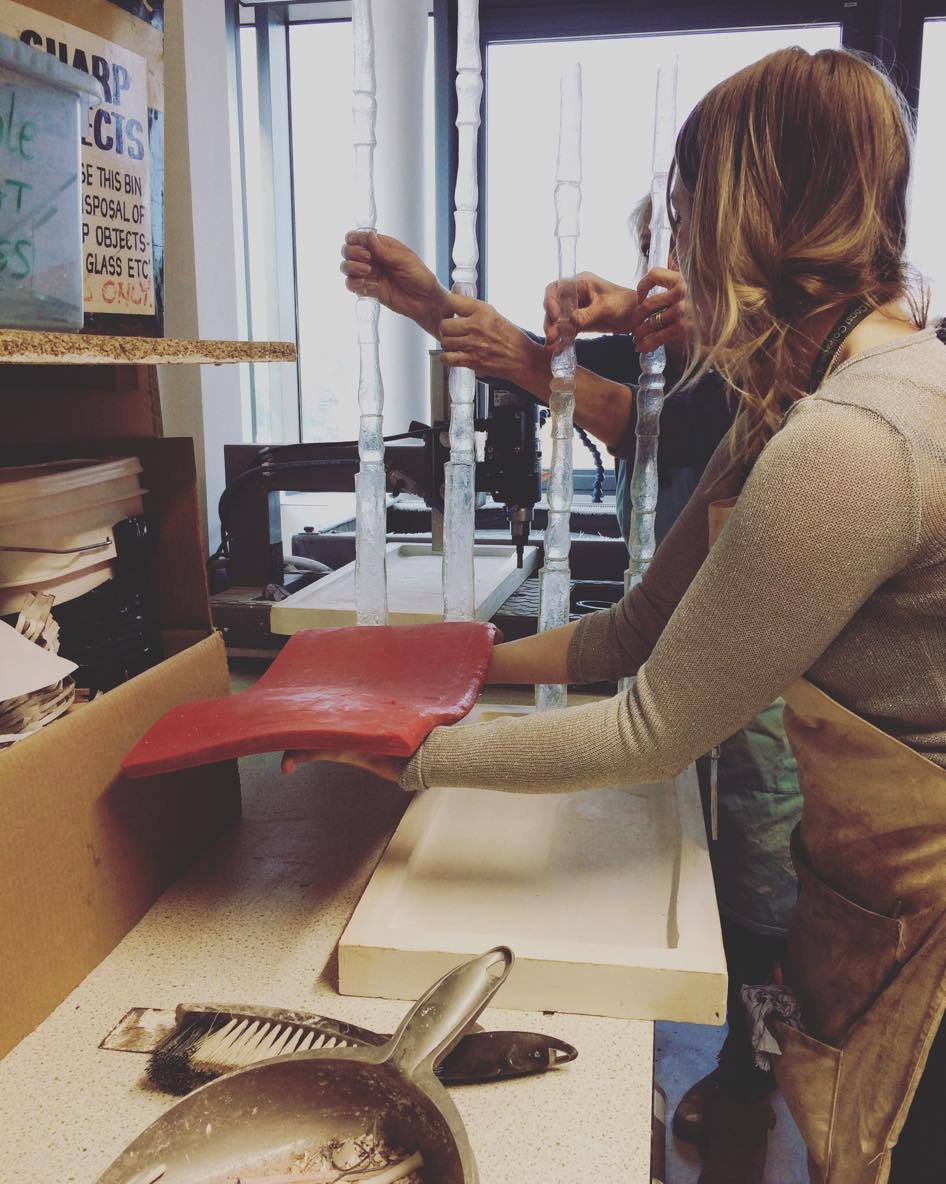
The glass stair case on show in this exhibition was a response to my exploration into the concept of space, in particular relation to the home. By casting the stairs and balustrades from my family home, the translation of marks and wear from the surface of such structures into glass provides a tangible representation of the significance a space can hold; an archival mapping of life, memory and existence. I wanted the work to be suggestive yet unimposing, a relatable and accessible piece to silently absorb the responses from those who experience it; to be thought provoking and meaningful. 

Where does your inspiration come from?
My inspiration stems from a range of sources. My work usually is idea led, concept before construct. To pin down what it is that I am trying to convey or explore, I use a range of research methods to gain knowledge and inspiration, usually reading around philosophical interpretations, historical and contextual connotations, and a range of other artists work and how they use materials to explore similar themes. 

The development of ideas for the glass staircase were particularly inspired by artists such as Rachel Whiteread and Doris Salcedo along with the literature of western philosopher Gaston Bachelard’s ‘The Poetics of Space’  and an intriguing article by architect Juhani Pallasmaa ‘Identity, Intimacy and Domicile. Notes on the Phenomenology of Home.’

Why is making art important to you?
I find myself analysing everything I see, hear and know through an inquisitive mind, constantly seeking answers and looking for meanings. Making art for me becomes a therapeutic type of reasoning, a way for me to understand and make sense of the world we exist in. Making is an essential part of life that takes on many varying forms for many different people. Art should not be seen as a mere add on to the basics of everyday life, but is an essential part of our existence and expression of who we are, it is woven into the fabric of life and allows a true representation of our internal self, exposing a voice in a world of many. 
  

What would help you to develop your art further in the future?
To be able to continue my experimental work in the discipline of glass, I aim to acquire a studio space and the equipment needed to do so, most importantly would be to get a kiln. As well as continuing my own artistic practice I would also like to run more adult and children’s workshops in the basics of kiln formed glass and perhaps develop some ideas for community projects, creating environments in which art and ways of making become accessible to all.  


website:     Martha Tanner 

Monday, 24 July 2017

Rising Talent - Satu Viljanen

Satu Viljanen  


I’m originally from Helsinki, Finland and I studied Carpentry and Product Design when I was still living there. My long term dream was to study Sculpture and that took me to move to London and enter university at Camberwell. After graduating in 2010 life took over and it’s been a journey to try to carve time for art. I’m happy to say this is my very first exhibition since uni. The previous studies and jobs working with the interiors have influenced my art practice. There’s an ongoing interest in how spaces affect us and how we affect spaces.

Which other artists do you like or find particularly interesting?
Tatiane Freitas uses old wooden furniture as a starting point and replaces some of the parts with transparent acrylic. The results are still functional pieces of furniture but they seem to be somehow elevated with this delicate otherworldly quality.

Richard Woods has designed playful cartoon like surfaces of real materials like wood, bricks and dry stone. He paints these surfaces on to objects, structures and buildings creating artworks that could also be seen as design or decoration.

I’m intrigued by the work of these artists because both of them blur the line between art and design.

Why is making art important to you?
By making art I encourage myself to concentrate on subjects and moments I wouldn’t necessarily otherwise notice.It allows me to be curious, geeky, and allocate time just for the wandering thoughts. And for me these wandering thoughts are needed to feel grounded and happy.

What would help you to develop your art further in the future?
I would love to find new people to have art conversations with. A positively critical peer group is so important when mulling over some new ideas or just wanting some advice. Also hopefully there will be some more exhibitions or other involvements to push me creatively and to keep me busy developing new work.


25th July – 6th August
Private View: 28th July 6.30 - 8.30

Sunday, 23 July 2017

Rising Talent - Branka Vrhovski-Stanton

Introducing ceramicist, Branka Vrhovski-Stanton

My interest in ceramics started with adult education classes, first in Croatia and then in UK. That was followed by a Diploma in Ceramics at Goldsmith College London, and subsequent self-employment as a ceramic maker and pottery instructor at various places.

A few years after, I started to write what I then understood as an article on the basic nature of such works in ceramics, that treat the hand built container type shape as a theme on its own.  That “article” soon managed to take the place of my making: something unimaginable to me before it actually happened, as ceramics was my dream-come-true kind of work. The writing took me on an epic journey, swallowing the next seventeen years and then some more, its wheels dragging as I was trying to disengage. Though still a part of my life, I no longer write except an occasional presentation that has so far not found its way into print.

In order to disengage myself from this venture and its all-consuming nature, I enrolled again in adult education classes to help me re-start with the making. When I was ready, my starting point, as before, has been the vessel form.

The works that I am showing now result from this period. All are hand built from rolled slabs of clay and/or coiled. They are painted with slips, engobes and glazes. Some are more planned then others. They present my exploration of this particular shape from three different yet intermingling aspects: pottery, expressive and painterly container oriented ceramics. How the work will continue, is yet to be seen.


Which other artists do you like or find particularly interesting?
In ceramics, mostly the makers whose work is centred on the empty ceramic container type work. Hans Coper, Gordon Baldwin, Alison Britton, Ken Eastman, Marit Tingleff, to mention a few. 
Painting interests me too (I was a self-taught painter before encountering ceramics). My latest interest is Roger Hilton’s work.

Why is making art important to you?
It is my therapy as is so often said, but also my need and sometimes -or often- my headache too. It is, as also said, primeval: it gathers the earth, the heat, the water and apprentices poor ceramicists who bring their offerings to the kiln for the kiln’s gods to decide!

It is also, for me, the primary form of all human arts: its primary content, the space we live in and that surrounds us and its mental counterpart, the consciousness, both simultaneously the most distant to our senses and the most intimately involved with us, it is also the content that potentially contains all.

What would help you to develop your art further in the future?
Time, as I am starting again and not in my prime, and opportunities to exhibit.


Rising Talent: Young and emerging artists at the Hastings Arts Forum 2017 
25th July – 6th August
Private View: 28th July 6.30 - 8.30

Saturday, 22 July 2017

Rising Talent - Helen O'Leary


Please tell us something about yourself and your art?
I came to art later in life after bringing up four children and helping to meet the needs of sick parents. I went to university at the same time as my oldest daughter. My intention had been to get completely away from textiles, in that regard I failed. I did an Applied and Media Art BA and went on to do an MA in Fine and Applied Art Practice.

I have spent my life doing serious renovation work on Victorian houses and a 300 year old cottage I lived in. The intrigue of the layers of plaster and wallpaper along with learning about methods of thatching and other old building and household crafts have all informed my working practice. The relationships I have had and still have with my children, their friends and my own, the complications of family life and the contrast between happy and sad times that inevitably come to families, also play a part in my work. 

I'm very interested in women's past associations with textiles. How, during the twentieth century, decorating, mending, washing and the general time consuming drudgery of keeping the household linen, repaired replaced and above all clean, meant “women’s’ work”. And the time it took and the social aspect, particularly in times of family and national crisis. From childhood girls would learn needlework at home and school, neat stitching for decoration and strength, and in working class households they would be expected to help with the laundry. Keeping the family clothes repaired and linen in good order on the washing line was an important measure in local society of the woman's worth and morals.

Clothes define us, they give a clue to the outside world about who we are and how we want to be seen. Clothing and bed linen take on certain characteristics of the wearer, the shape we are, the way we move. Clothing and linens bobble, thin, tear and scuff often in characteristically different places. Clothing and skin begin to share many similarities with age. Old clothing holds the memories of past occasions when we allow the time to think. From a background in fashion I am constantly drawn back to textiles and textile techniques, bringing in other media when appropriate. I work generally in three dimensions, frequently starting with a mixed media work I have made from layers of materials and then carefully paring back the layers and adding details.I also work with old photo images printed on used fabric, wire, plaster of Paris, old dolls, tin cans and other found objects.


Which other artists do you like or find particularly interesting?
Artists I admire and frequently refer to when losing my way are Ann Hamilton, for all the detailed research behind her work and her ambition in the large scale installations she makes. She frequently involves other women and artists in her awe inspiring textile works. Annette Messager and her concept of others within each of us. Her installation of stuffed toys with heads switched from one animal to another, gives a sense of disguise and transformation. Anselm Kiefer for the materials he uses, the way he uses them and a sense of absence I feel when looking at much of his work. He confronts our dark past and brings us face to face with size and scale through his works. The immersive art of Mona Hatoum, her mixture of surrealism and minimalism amazes and excites me. Her sense of familiarity and the uncanny disturbs and intrigues me.

Why is making art important to you?
Though I don't consciously use my past experiences to inform my work it continues to find its way in. Art enables me to express my experiences understanding that even difficult times are part of who we are and we must look to the future in a positive way. I constantly return to research my main interest in the use of textiles by women in the past and use this research to inform my textile practice. I of course enjoy feedback from anyone who sees my work especially if they gain any understanding of where the work originates and can relate it to their own lives.

What would help you to develop your art further in the future?
To further develop the use of photographic images on used fabric I need to make a dark room at home. The process involves soaking the fabric in photo emulsion and drying it in full darkness which takes about 24 hours, then it can be used as normal photo paper. This process embeds the image into the fabric so it can even be washed in the machine. Just inkjet printing onto many cotton fabrics seems more obvious that the print is on the surface. I need to find the confidence to promote my work harder, I have recently become a member of Studio 21 textile group where we have mentoring sessions as well as high profile exhibitions. As I have only recently moved to the Hastings area it would be good to meet up with local textile or mixed media artists to discuss working methods.


To see more of Helen's work see the website: HELEN O' LEARY WEBSITE


25th July – 6th August
Private View: 28th July 6.30 - 8.30

Rising Talent - Amelia Allden

I am really enjoying the diversity of responses we are receiving from our Rising Talent interviews. Next up is mixed media artist, Amelia Allden. 


I am aged 46 and have spent many years creating using various mediums but never really considered or even realised that I was capable of creating pieces of artwork that would peak peoples interest.

I have no formal art training, everything I do is self-taught. I have a very deep passion for vintage things and history and I adore rummaging to find treasure for my pieces. All my pieces have at least one item that is re-purposed, which gives me an added sense of achievement that I am able to re-use and save things from being sent to landfill.

When I first started creating in mixed media, I never really knew much about the art world or artists, then I stumbled across an artist called Greg Hanson from America and I found his art very inspiring, unique & interesting.  He often made mention that he was inspired by Joseph Cornell, a famous artist who created amazing assemblage work. So I did some research and Yes: his work begin to inspire me too! I adored his use of moveable objects in his assemblage pieces and I often try to create movement in my own pieces. 

I sell work locally and I have a Facebook page called ‘Amelia’s Altered Art’ where I also sell pieces. I have many loyal customers who often purchase pieces as far afield as British Columbia.

Creating art is like a form of therapy to me, it helps to relax my mind when the stress of being a parent of an autistic child gets too much. Nothing gives me greater pleasure than knowing that someone somewhere is also enjoying my creations.


I really hope the above gives you a greater insight into what inspires me and why I create.

To see more of Amelia’s work please see her Facebook page here: Amelia’sAltered Art

25th July – 6th August
Private View: 28th July 6.30 - 8.30