Monday, 31 October 2016
The Big Draw at the Hastings Arts Forum
I missed the Big Draw which is a shame. I came into the Hastings Arts Forum this morning and got to see the last few pieces from the Big Draw before they were all taken down and packed away. I really wish I had seen more now - they are colourful, spontaneous and fun but also connected to the serious realities of the present. This is all that remained hanging up today so just a few pictures I'm afraid.
Tuesday, 4 October 2016
Roberto Landin Solo at the Hastings Art Forum
Unusually for the Hastings Art Forum, the next two weeks
will feature just one artist in the whole two-gallery space. It is not easy for
a single artist to fill up this much space with consistently good or
interesting work, especially at short notice, so what Roberto Landin has achieved here is really quite
spectacular.
Gallery One is hung with large paintings that use simple and harmonious spectrums often
containing metallic hues to reflect the light in the room. The paintings are
the newest works of Roberto Landin and four of them were made especially for
this Hastings Art Forum show.
They are accompanied by a totem of brightly coloured ceramic
skulls that complement the use of colour in the room. A smaller totem of green seems to form a single piece with the painting behind it, while shiny, white skulls,
cones and other decorative ceramics, beautifully glazed or part-glazed, sit almost
in piles on ascending plinths.
This gallery is a showcase for the artist’s colour
sensitivity in paint and for his skill as a ceramicist. The
combination of colours, objects and shapes and the way in which they are arranged
has left nothing to chance and it looks fantastic.
From the seamless arrangement of Gallery One you step into
the equally seamless Gallery Two. The room is made dark by blackout curtains and is lit entirely by hanging and sculptural light installations that cast a delicate, subterranean neon glow. Entering this room you encounter four massive sculptures of human
bodies that are very far from the idealised and unrealistic norm. All
are beautifully lit and their equally massive shadows rise majestically up to
the ceiling above.
This room is composed of earlier works. The oldest is a huge canvas
of two figures, one with a protruding tongue, painted over the pages of a bible.
The tongue is a motif that recurs in several different forms including an intimate video installation
viewed in soft orange focus through a perspex box. It also features in two mirrored works - one contains a circle of sacred hearts,
tongues and organs fused into one object, while the other has two rows of disembodied tongues chattering into infinity.
This gallery has an element of circus sideshow in which the audience comes to see a spectacle, possibly something grotesque, that
reaffirms perceptions of their own normality. However, as soon as they step
inside they are part of the show and the boundary between what is perceived
as normal and what is not ceases to exist. Such merging of art and audience is underlined by the fact that Roberto Landin is also a performance artist and there are two performances scheduled.
The first will be a meditation on sound in which the audience is asked to understand sound as something physically felt rather than heard. This will explore how the body resonates with sound and how that connects to the emotional catharsis often associated with music. Performance times are is 12pm to 4pm on Saturday October 8th.
The second will be a meditation on gender. The artist will appear androgynous and will sit facing an empty chair. Members of the audience can sit opposite the artist for as long as they wish. No words will be exchanged. The point is to feel and reflect on what you have seen using the artist’s performance persona as a projection board for your own response.This will take place from 12pm – 4pm on the following Saturday October 15th.
What is contained in the two galleries is pretty much the
entire creative output of Roberto Landin since 2010, which gives the show the feel of a small retrospective.
However, it also reflects a very contemporary artistic practise. This is not an exhibition
so much as a complete artist environment which makes it as
contemporary as it gets. It is something for the visitor to experience rather
than to view and has the potential to transform, particularly in the context of
the performances. It may also transform some perceptions of what art can or should be. Not one to miss.
From Light to Dark
4th October – 16th October
Private View: Friday 7th October - 6.30 - 8.30pm
Hastings, East Sussex
Hastings, UK
Tuesday, 20 September 2016
Paperworks at the Hastings Art Forum
20 September – 2 October
Private View: 23rd September 6.30 - 8.30
Traditional expectations of works on paper are drawing or watercolours. However, this group exhibition completely overturns any conservative notion of how paper should be used in art. The only works that appear to be watercolours in this show are far from traditional and the drawing consists of graphite renditions of rubbed pavements reassembled into huge paper rolls.
This is a celebration of one of the oldest, most flexible and varied materials we have. It is paper as a means to convey images in multiple forms, as a material for sculpture or installation and as recycled object transformed from practical to conceptual use. In the latter category, for example, books such as the one below must be opened by the viewer to make sense.
The beautifully produced concertina artist books of Nikki Davidson Bowman are collages of images and words perfectly bound into multi-dimensional art objects. Caroline Sax's tiny sculptures are unrecognisable as paper and seem to be made of a different and harder substance altogether.
There is a humorous nod to the subject in several of Ian Barraclough's prints, particularly his depiction of the unique qualities of the final sheet on 9 different toilet rolls.
Gill Streater's work reminds us of the importance of paper to calligraphy while Helen Rawlinson uses paper like a textile on which to add thread, buttons and colours to create small and imaginative abstracts.
Collage features in several guises in this exhibition. The pop art sensibilities and clean minimalism of Duncan McAfee, the apocalyptical colour and atmosphere of Kate Gritton and the surreal compositions of Jeff Stancliff which are compelling, mysterious and not entirely comfortable to view.
As always with such a large group show there is too much to comprehensively preview plus the detail in the works cannot possibly be conveyed here. So to conclude here are images that cover all the participants with their websites following below.
Paperworks at the Hastings Art Forum
20 September – 2 October
Private View: 23rd September 6.30 - 8.30
Participating Artists
Wednesday, 7 September 2016
Silver Fish, Vermin and Volunteers
Silver Fish and Vermin
“We both live in the middle of the countryside surrounded by all sorts of vermin (rats, foxes, fly-tippers etc). It is hard to find beauty in everything and vermin definitely bring out emotion and reaction where ever they appear. Everyone has their pet hate, hopefully our exhibition will be able to shine a humorous light on some.” Liz Boast and Kirsten Wilson
Unlike many of the exhibitions at the Hastings Art Forum Silver Fish and Vermin is truly a joint show. Liz Boast and Kirsten Wilson’s work is arranged together throughout the gallery and includes a wonderful collaborative piece entitled ‘The Alphabet of Vermin’ which is composed of 27 individual works. This alone deserves time and close study to take in the details, the stories and just the sheer fun and scope of the piece.
Both artists are multi-skilled and this exhibition covers all facets of their work. As well as paint, print and mixed media both are excellent silversmiths. This means the inclusion of a contemporary jewellery collection beautifully presented on woodblock stands which are lovely objects in their own right.
Consequently there is a lot in Gallery 1 to keep you entertained. Silver, wood and a delightful tumble of creatures and landscapes with flying birds, harlequins, schools of swimming fish, strange children, rats, circular zodiacs and ghostly figures emanating light.
The Volunteers Show
The joy of multiple diversions continues into Gallery 2 which is hosting the annual exhibition for volunteers at the Hastings Art Forum.
Almost all of the volunteers at the Forum are artists in their own right. There are painters, photographers, printmakers, sculptors, ceramicists, glass artists and others who are some and possibly even all of the above. Without the volunteers the forum could not function and this annual exhibition is a thank you and a way for the volunteers to get together as artists rather than all the other roles they perform behind the scenes.
I have to declare a conflict of interest here. I am a volunteer at the Hastings Art Forum which means I have some of my own work in the show and know many of the other people exhibiting. So when I say that this is absolutely the most excitingly diverse and brilliant exhibition you will see at the Forum this year, you probably need to take it with a pinch of sea salt. Not too much, however, because this really is an exciting show.
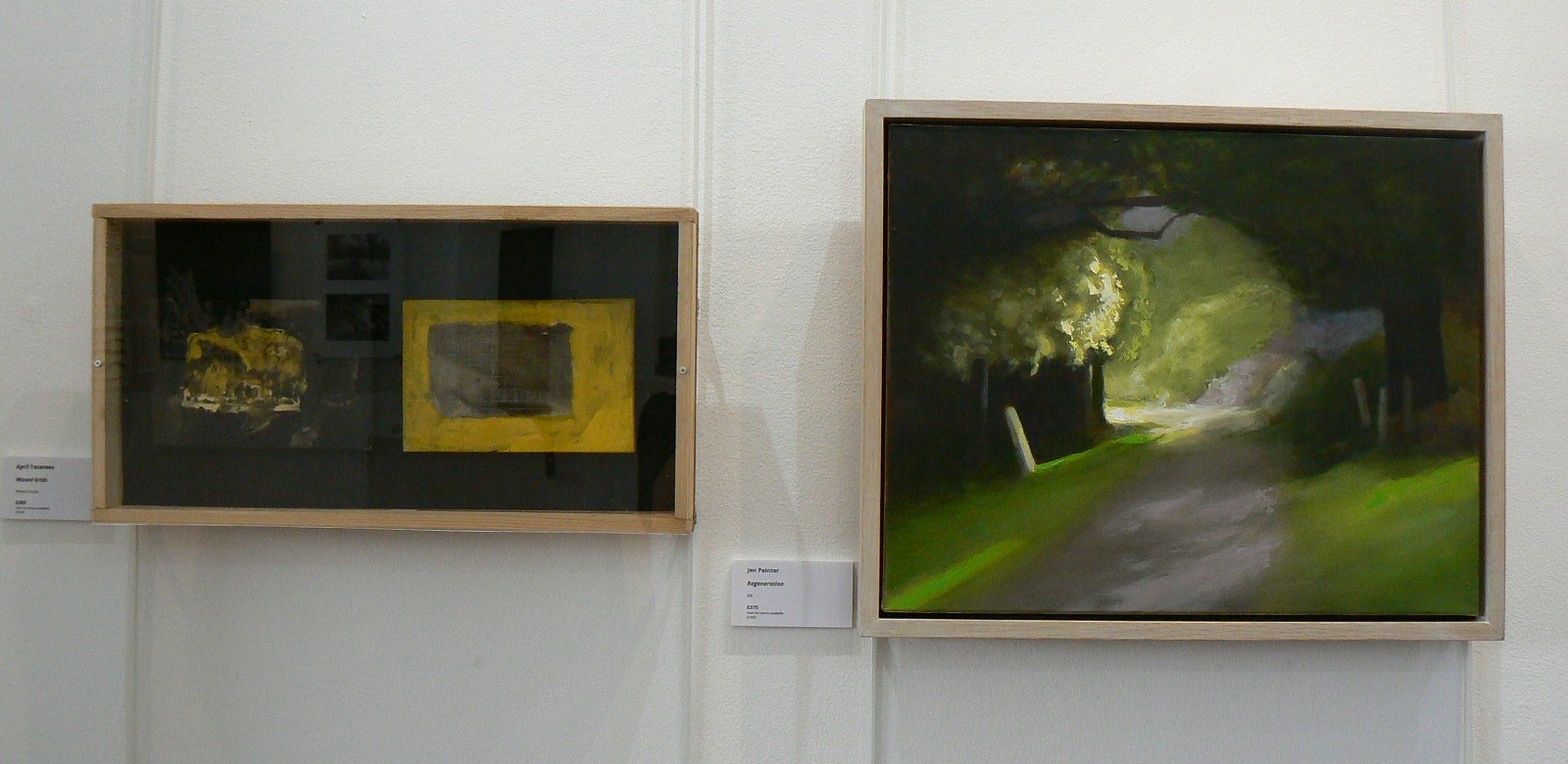
In fact, there is so much to talk about I don't know where to start so instead of talking I am just going to name all the participants with links (where I could find them) and post up a whole load of photos. These cannot convey the detail, the subtlety, the humour or the range of subject and form but it will give a sense of the skill and diversity that you can see here. It’s wonderful :)
The Volunteers
Alice Maylam April Yasamee Carlen Fritze
Caroline Sax Charlotte Morris David Murphy
Dawn Timmins Edwina Truelove Gill Streater
Howard Seaton Jen Painter John Hacker
John Plummer Julie Willard Kate Gritton
Katherine Reekie Mark Border Molly Durman
Sally Meakins Sharon Moore Susan Miller
Suzy Tinker Trish Kilczewski Valerie Grove
Consequently there is a lot in Gallery 1 to keep you entertained. Silver, wood and a delightful tumble of creatures and landscapes with flying birds, harlequins, schools of swimming fish, strange children, rats, circular zodiacs and ghostly figures emanating light.
The Volunteers Show
Almost all of the volunteers at the Forum are artists in their own right. There are painters, photographers, printmakers, sculptors, ceramicists, glass artists and others who are some and possibly even all of the above. Without the volunteers the forum could not function and this annual exhibition is a thank you and a way for the volunteers to get together as artists rather than all the other roles they perform behind the scenes.
I have to declare a conflict of interest here. I am a volunteer at the Hastings Art Forum which means I have some of my own work in the show and know many of the other people exhibiting. So when I say that this is absolutely the most excitingly diverse and brilliant exhibition you will see at the Forum this year, you probably need to take it with a pinch of sea salt. Not too much, however, because this really is an exciting show.
In fact, there is so much to talk about I don't know where to start so instead of talking I am just going to name all the participants with links (where I could find them) and post up a whole load of photos. These cannot convey the detail, the subtlety, the humour or the range of subject and form but it will give a sense of the skill and diversity that you can see here. It’s wonderful :)
Silver Fish, Vermin and Volunteers
Private View: 9th September - 6.30 - 8.30
Both shows run from 6th Sepember – 18th September
The Volunteers
Caroline Sax Charlotte Morris David Murphy
Dawn Timmins Edwina Truelove Gill Streater
Howard Seaton Jen Painter John Hacker
John Plummer Julie Willard Kate Gritton
Katherine Reekie Mark Border Molly Durman
Sally Meakins Sharon Moore Susan Miller
Suzy Tinker Trish Kilczewski Valerie Grove
Tuesday, 23 August 2016
Robin Holtom and Michael Wilson
Both artists in the current show at the Hastings Art Forum
present an impressive mix of painting and sculpture. Robin Holtom’s seven sculptures of dancers and nude female
figures are cast in bronze or ingeniously made from plaster reworked and
painted to give the surface appearance of bronze. The exception is a
white plaster head between two mostly white drawings, themselves exceptions to this show's rather beautifully coloured rule.
The almost exclusive use of darker toned blues, purples, oranges and greens creates an
atmosphere of restfulness and stillness in this gallery that also emanates from the buildings
and figures in each of the compositions. Skylines at sundown have an early evening hush while the natural and reflected
abstracts of Venetian architecture are shaped into blocks and lines of
colour.
Groups of female figures and dancers are composed without
physical detail which gives them a slightly ghostly but still sculptural
quality. When there is an occasional hint of movement it is slow, gentle and
considered. Using combinations of the same colours to depict hard surfaces like
walls and steps in one piece, alongside the soft surfaces of the human body in
another, is a lovely juxtaposition completed by the seamless transmutation of the human form into bronze.
Michael Wilson’s sculptures are very different in style,
subject and substance. Made of light coloured stone, each depicts a biblical story
or figure. Surfaces are smoothly worked and the solidity and suggestion
of weight gives each piece a strong and captivating presence. The colour and work in the stone is enhanced by the bright airiness of the landscapes around it.
Michael Wilson lives locally and the majority of the paintings
are recognisable Sussex landmarks, views or rural scenes. Many are perfectly executed with a scale
and perspective of somebody moving through the scene depicted. This is particularly effective in the paintings of the Seven Sisters, the view from West Hill and some of the rural scenes. Trees also feature strongly in many of the paintings and I particularly liked the almost electric blue of the trees in ‘Out of the Valley’.
However, there is a very strange anomaly in Michael Wilson’s exhibition. Displayed on the end wall is a five piece asymmetric panel depicting
the story of Oedipus. Although foundational
Greek myths are perhaps a natural historical companion to biblical scenes, the work itself lacks any harmony with the other paintings in the room. It is almost as if a less accomplished artist
sneaked into the gallery and installed it when nobody was looking. Incongruity can be interesting but here it detracts attention from the rest of the work which is unfortunate.
The predominant focus of Michael Wilson's paintings also restricts the colour palette but the lighter, brighter and more expansive feel is a perfect complement to Robin Holtom’s minimal colour range next door. There is a link also in Michael Wilson’s pastel studies of nudes, one of which is a female figure reclining in similar pose to one of Robin Holtom’s sculptures. The differences and the similarities in these two shows communicate much about how art is both created and viewed. Each of the artists in this show are mostly painting or modelling a place, a person or a scene that they have observed or are observing. The experience of the audience is that the viewer remains the intimate observer in Robin Holtom’s work whereas it is possible to almost step inside the paintings of Michael Wilson.
Such combinations of 3D and 2D work in one space are always very satisfying to view. They make the exhibition more interesting to navigate and the visual interaction between the two can create other unexpected observational delights.
Robin Holtom and Michael Wilson
Hastings Art Forum
August 23rd - September 4th 2016
Private View Friday 26th August
Subscribe to:
Posts (Atom)
